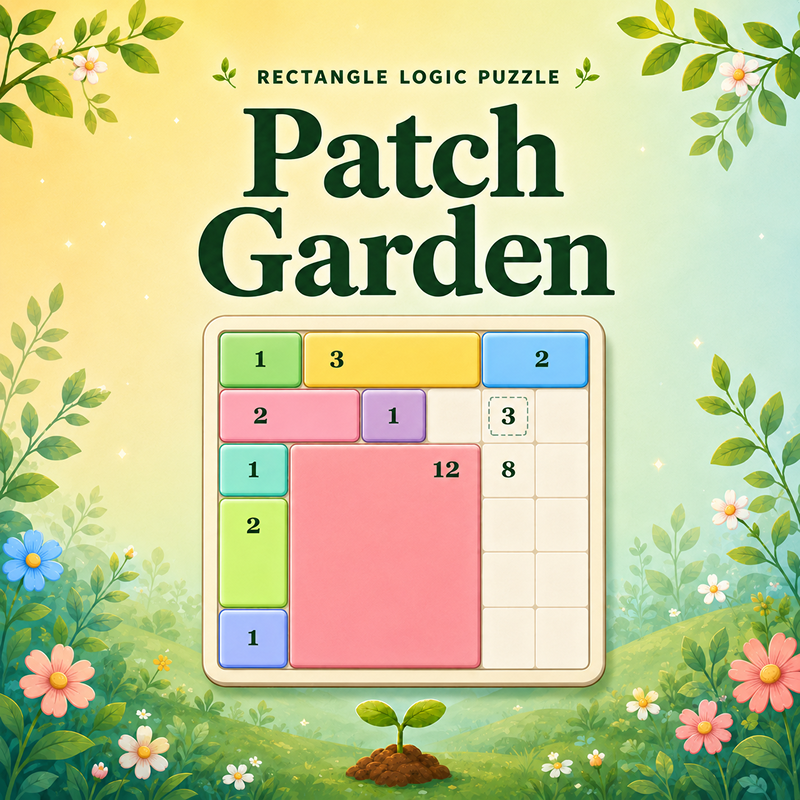
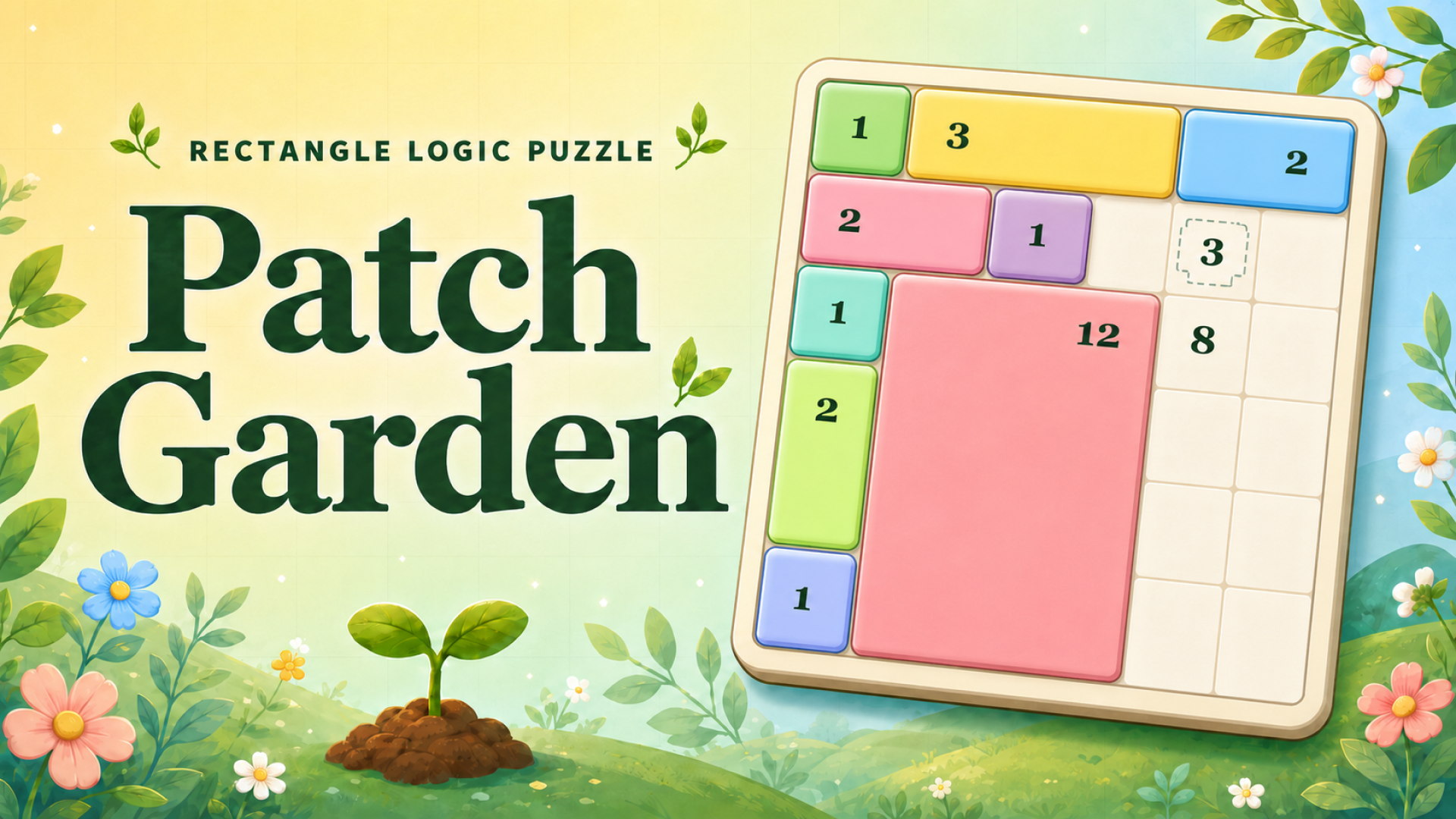
Patch Garden - Play Online
Draw rectangles, match seed clues, fill every cell. Patch Garden hands you a blank grid and a handful of numbered hints—each number marks one rectangle's area. Drag across cells to claim territory, avoid overlaps, and complete the board before the clock ticks down. Hundreds of levels crank up the deduction pressure with bigger grids, mystery seeds, and exact-size challenges that demand flawless spatial reasoning.
How to Play Patch Garden
Fill the entire board with non-overlapping rectangles. Each seed clue anchors exactly one patch, and that patch's total cell count must equal the number shown. Cover every square, leave zero gaps, and hit that three-star rating.
Drawing Rectangles
Click and drag on desktop, or swipe on mobile, to sketch a rectangle from one corner to the opposite. Ctrl+Z undoes mistakes; tap the Erase button to remove a bad patch. Every level starts with a clean grid—plan your first rectangle carefully, because one wrong shape cascades into unsolvable chaos. The Puzzle games catalog on Playgama rewards this kind of methodical grid mastery.
Unlocking New Gardens
Complete a level to unlock the next in the 450-stage progression track. Star ratings reflect speed and move efficiency—finish under par to earn three stars, then chase leaderboard times. Mystery seeds hide their area values until you deduce them from surrounding clues, ramping difficulty as boards expand to 10×10 grids and beyond. If you enjoy spatial constraint-solving, Arrow Puzzle shares Patch Garden's core logic-deduction DNA, challenging you to remove arrows in sequence to clear grid-based mazes.
Strategy and Pro Tips
Tackle corner clues first—corners limit possible rectangle orientations, anchoring your solve. Work inward from edges, using elimination to pin down mystery seeds. Watch the percentage progress bar: if you're stuck at 80 percent, scan for orphaned cells that reveal the missing rectangle. Mahjong Classic appeals to the same patient, pattern-matching mindset required in Patch Garden, swapping rectangle placement for tile-pairing strategy. Use the hint system sparingly—each hint highlights one correct solution area, but overuse slows your time-based star rating.
Key Features
- 450 handcrafted levels: Gradual difficulty climb from 3×3 tutorial boards to sprawling 10×10 logic nightmares.
- Clean vector aesthetic: Soft pastoral palette with high-contrast serif UI for instant readability on any device.
- Star rating system: Earn three stars per level by minimizing moves and seconds; completion times track on the progression overlay.
- Cross-platform browser play: No downloads—click and start solving on desktop, mobile, or tablet via Playgama.
Who is Patch Garden for?
Casual puzzle fans aged 25-55 hunting stress-free brain training. If you unwind with Sudoku or Picross, the Shikaku-style area-division mechanic delivers the same meditative satisfaction. Block Blast 2048 delivers calm, grid-filling satisfaction similar to completing a Patch Garden level, replacing rectangle-drawing with adjacent number merging. Players who value clean design over flashy effects will appreciate the magazine-quality typography and low-overhead vector art. For fans exploring Ai Games games, this title blends procedural challenge generation with intuitive drag controls.
Developer
Patch Garden was developed by Westeren Games. The studio leverages Unity to deliver smooth rectangle-dragging across mobile and desktop browsers, wrapping traditional Japanese Shikaku logic in a cozy garden skin that appeals to the casual hyper-mobile demographic.
Controls
- Mouse Click & Drag (Desktop): Draw a rectangle across the grid.
- Touch Drag (Mobile): Swipe from one cell to another to create a patch.
- Ctrl+Z (Desktop): Undo your last move.
- Undo Button (Mobile): Tap to reverse the previous action.
- E (Desktop): Activate Erase mode, then click a patch to delete it.
- Erase Button (Mobile): Tap to activate Erase mode, then tap a placed patch to remove it.
- H (Desktop): Trigger a hint to highlight a correct solution area.
- Hint Button (Mobile): Tap to reveal a helpful rectangle placement.
FAQ
Can I play Patch Garden on mobile and desktop?
Yes. Patch Garden runs in any modern browser on Android, iOS, and desktop. Touch drag on mobile mirrors mouse drag on desktop—same puzzle logic, zero downloads.
How do star ratings work in Patch Garden?
Each level awards up to three stars based on completion time and total moves. Faster solves with fewer rectangle redraws earn higher star counts, which unlock leaderboard milestones and track on the progression overlay.
What are mystery seeds?
Mystery seeds hide their area values until you deduce them from surrounding clues and grid constraints. They appear in mid-to-late progression levels, forcing pure logic instead of number-matching.
How many levels does Patch Garden include?
The game offers 450 handcrafted levels, starting with simple 3×3 tutorial grids and scaling to complex 10×10 boards with multi-clue deduction chains.
Is Patch Garden similar to other logic puzzles?
It uses the Shikaku mechanic—dividing a grid into rectangles matching numeric clues—wrapped in a cozy garden theme. If you enjoy Sudoku constraint-solving or Nuts Puzzle: Sort By Color spatial organization challenges, Patch Garden delivers the same satisfying deduction rhythm.