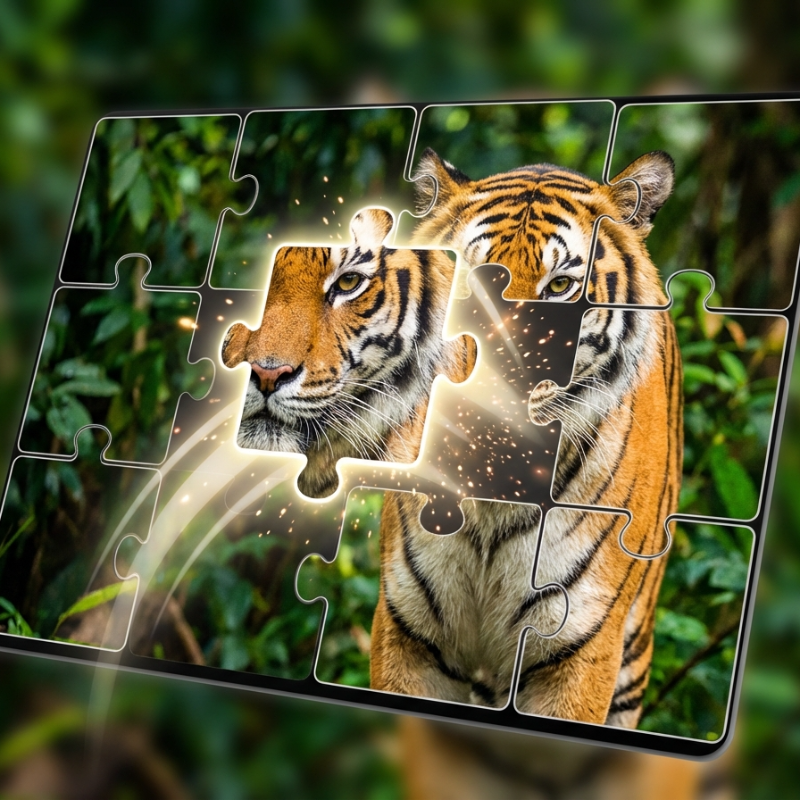
Ever tried solving a jigsaw puzzle where you can swap pieces instead of hunting for the right fit? Solitaire Picture Puzzles strips the classic sliding puzzle down to pure strategy—drag, swap, match. Your mission: reconstruct stunning real-world photographs by rearranging shuffled tiles on a grid. Start with gentle 3x3 layouts and graduate to brutal 5x8 challenges that'll test your spatial memory like a Rubik's Cube on expert mode.
The rules click in seconds, but mastering the swap logic takes patience. Here's the three-phase breakdown:
You click (or tap) any tile and drag it onto another. They swap positions instantly. On desktop, your mouse does the heavy lifting. On mobile, it's pure touch-and-drag. The controls are butter-smooth—no lag, no missed inputs. Early levels let you brute-force your way through, but once you hit those 4x4+ grids, random swapping becomes a time sink. You need to visualize the final image.
This is where the game separates casual swappers from puzzle veterans. Adjacent tiles that form part of the correct image "lock" together visually—they stay grouped when you drag them. Pay attention to edges, colors, and shapes bleeding across tile borders. A piece of sky might touch a rooftop fragment. Once matched, those tiles move as a unit, shrinking the chaos. The more matches you create, the faster the full picture reveals itself.
After Level 9, the game stops holding your hand. Challenge grids introduce empty slots—dead zones where no tile exists. Now you're solving a hybrid sliding puzzle mixed with strategic swaps. The difficulty spike is real. A 5x8 grid with scattered fragments demands you map out the entire solution in your head before committing to moves. There's no move counter punishing you, but inefficient swapping just delays satisfaction.
This game targets the "Zen Puzzler" demographic—players who want cognitive stimulation without twitch reflexes or time pressure. If you enjoy Sudoku, nonograms, or classic jigsaw apps, you'll vibe with this. It's perfect for commutes, lunch breaks, or decompressing after work. The retro-inspired minimalist aesthetic keeps distractions at zero, letting you hyperfocus on tile logic. Kids under 10 might struggle with the spatial reasoning, but teenagers and adults will find it addictive.
The experience feels like meditative problem-solving mixed with tiny dopamine hits. Every correct match triggers a subtle "click" in your brain—that satisfying moment when two fragments align and you see part of a deer's face or a cobblestone street emerge. The stripped-back visual style isn't a limitation; it's intentional. By using clean grids and zero UI clutter, the game forces you to stare at the photograph itself. No particle effects, no flashy animations—just you versus the puzzle. The lack of a timer removes stress, but the escalating grid complexity ensures you're never bored. It's a chill grind, not a sprint.
Your progress saves automatically via browser cache—close the tab mid-puzzle and return later without losing your place. The game runs flawlessly on potato PCs and ancient smartphones because the rendering is absurdly lightweight. We're talking static images on a grid, zero 3D processing. A 2015 laptop handles it like a champ. Mobile performance is equally solid; the touch controls respond instantly, and the portrait/landscape orientation adapts without breaking the layout. No downloads, no installs—just open the URL and start swapping.
A no-nonsense brain teaser that respects your time while challenging your spatial IQ.
Responsive and intuitive. Desktop players get precise mouse control; mobile users enjoy instant touch drag-and-drop. No accidental swaps, no sticky inputs.
Developed by Ray's Games and released on February 6, 2026. The studio focuses on accessible puzzle experiences that prioritize clean design over feature bloat.