
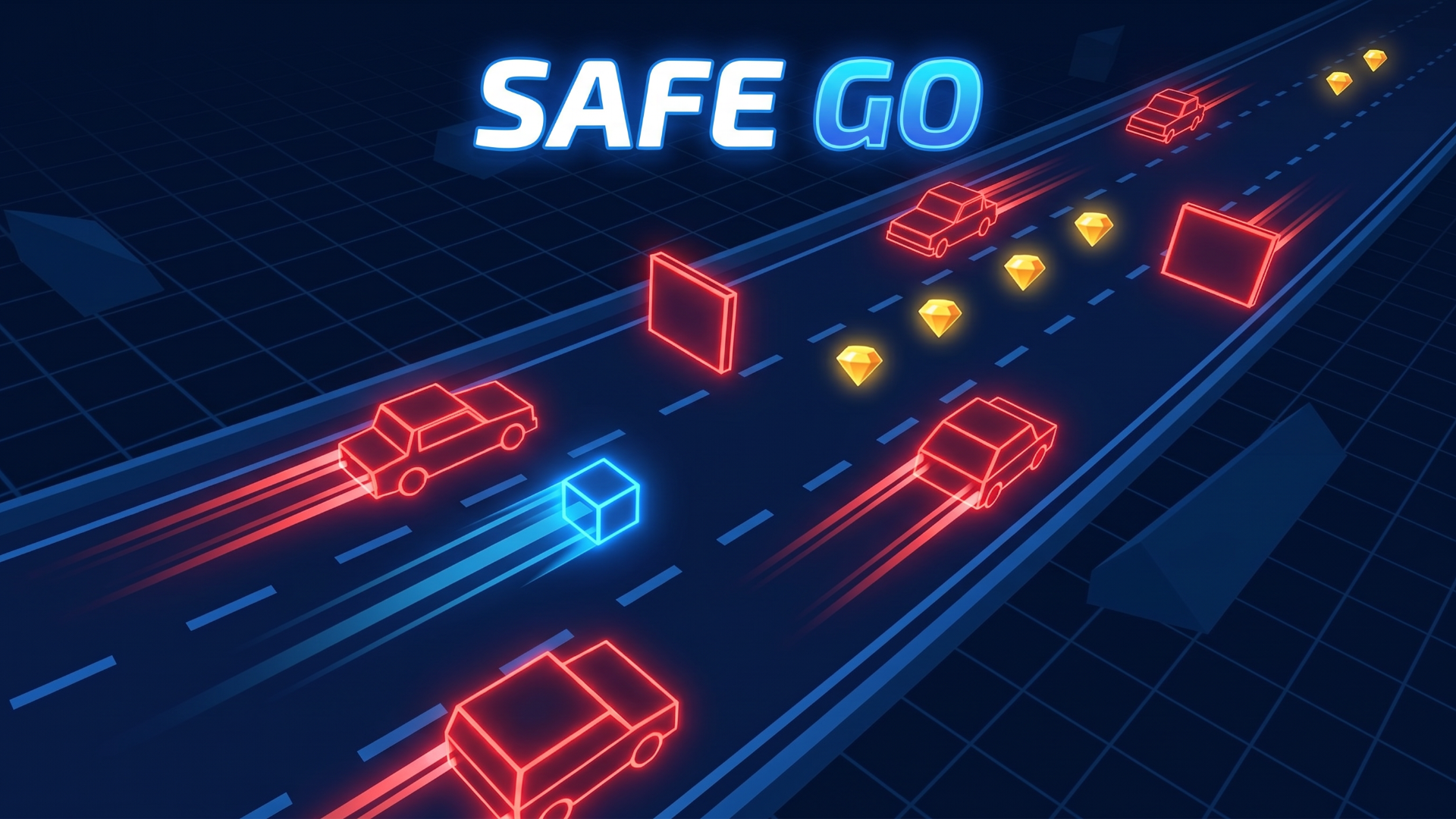
Safe Go - Play Online
Snap reflexes into gear. Red barriers scream down your lane. Switch left, switch right, collect gems, survive. Each phase cranks the speed until one wrong tap ends it all. Twenty levels stand between you and completion—velocity increases, reaction windows shrink, and every collected gem feeds your score. Click and play on any device with no downloads required.
How to Play Safe Go
Stay alive across twenty escalating phases by switching lanes before red obstacles crush your blue unit. Collect gems for score. Miss a dodge, game over. Desktop players use arrow keys or A/D; mobile players tap left or right screen edges. Pause with center tap or P key. Dynamic difficulty adjusts mid-run based on your performance, ensuring no two attempts feel identical.
Lane-Switch or Die
Four vertical lanes confine your movement. Red barriers spawn at the top and barrel downward. Tap left or right to shift lanes instantly—no animation delay, no forgiveness window. Your blue unit snaps into position as obstacles close the gap. Swipe gestures work on touchscreens, but precise taps outperform frantic drags when speed hits maximum. Arcade games like this reward muscle memory over hesitation. Collect yellow gems mid-dodge to inflate your score multiplier. Miss one, lose nothing; miss a red wall, reset.
Twenty Phases of Escalation
Phase one feels leisurely. By phase ten, patterns overlap and spawn intervals compress. The game tracks successful dodges and adjusts barrier frequency accordingly—string together fifteen perfect maneuvers and the next wave arrives faster. Geometry Arrow 2 players will recognize the pacing philosophy: survive long enough to trigger the next difficulty spike, then adapt or restart. Each phase completion awards bonus gems and unlocks the next tier. Vector graphics keep visuals clean at maximum velocity, ensuring red obstacles never blur into background clutter.
Pattern Recognition Under Pressure
Early phases alternate single-lane threats. Later stages stack obstacles across three lanes simultaneously, forcing you to identify the safe column in milliseconds. Watch the top screen edge—barriers telegraph their spawn position one beat before launching. Motorcycle Racer: Road Mayhem veterans understand the rhythm: anticipate, move, recenter, repeat. Gem clusters appear between obstacle waves—greed costs runs. Pause between phases to reset your mental tempo; the game doesn't penalize strategic breathers. Late-game success requires pre-planning three moves ahead while executing the current dodge.
Key Features
- Dynamic Difficulty Adjustment: Performance tracking scales obstacle frequency and spawn speed in real-time, preventing plateaus and ensuring every playthrough challenges your current skill ceiling.
- Minimalist Vector Aesthetic: High-contrast neon shapes with primitive glow shaders maintain visual clarity at maximum velocity, keeping red barriers distinct against the dark background across all twenty phases.
- Dual-Currency Progression: Gems accumulate per run and persist after death, rewarding consistent attempts with tangible score progression even when perfect runs remain out of reach.
- Twenty Escalating Phases: Each tier introduces faster spawn rates, tighter lane configurations, and overlapping barrier patterns that demand evolving strategies beyond simple left-right reflexes.
Who is Safe Go for?
Built for players craving fifteen to sixty-second hyper-casual sessions between tasks. Perfect for reflex junkies chasing personal bests, mobile commuters needing instant action without tutorial bloat, and Geometry Dash Wave: Original fans seeking rhythm-adjacent avoidance gameplay stripped to mechanical essentials. Desktop keyboard warriors and touchscreen tappers share identical core loops. Age rating sits at zero-plus—abstract shapes contain zero violence, blood, or narrative content. Speedrunners hunting optimal gem routes and casual players testing basic coordination both find traction here. Escape Tsunami for Brainrots enthusiasts familiar with survival-under-pressure mechanics will adapt instantly to the lane-switching formula.
Developer
Safe Go was developed by Rohan Kumar. The game delivers tight lane-switching mechanics through a browser-based arcade framework requiring zero installation across desktop, iOS, and Android devices.
Controls
- Left Arrow / A / Q: Switch to left lane
- Right Arrow / D / Space: Switch to right lane
- P / Esc: Pause game
- Tap Left Screen Edge: Move left (mobile)
- Tap Right Screen Edge: Move right (mobile)
- Tap Center: Pause (mobile)
- Swipe Left/Right: Lane switch via gesture (touchscreen)
FAQ
How do I unlock later phases in Safe Go?
Complete each phase without collision to unlock the next tier. The game saves your highest unlocked phase—restarting from phase one is optional. Progression halts only when a barrier connects with your unit.
What happens when dynamic difficulty adjusts mid-run?
String together consecutive successful dodges and the game decreases spawn intervals or increases barrier velocity within the current phase. Miss repeatedly and the system temporarily reduces pressure to prevent frustration loops.
Do gems persist after I fail a run?
Yes. Collected gems add to your cumulative score and remain banked between attempts. Only phase progression resets on collision—currency accumulation continues across all runs.
Which control method works best for late-game phases?
Keyboard inputs on desktop offer zero latency for rapid double-switches. Touchscreen players should use direct taps on screen edges rather than swipes—gesture recognition introduces millisecond delays that become fatal past phase fifteen.
Can I play Safe Go offline once loaded?
The web-based engine requires initial connection to load assets. Once the game boots in your browser, temporary disconnections won't interrupt active runs, but score syncing and phase unlocks require reconnection to save progress.