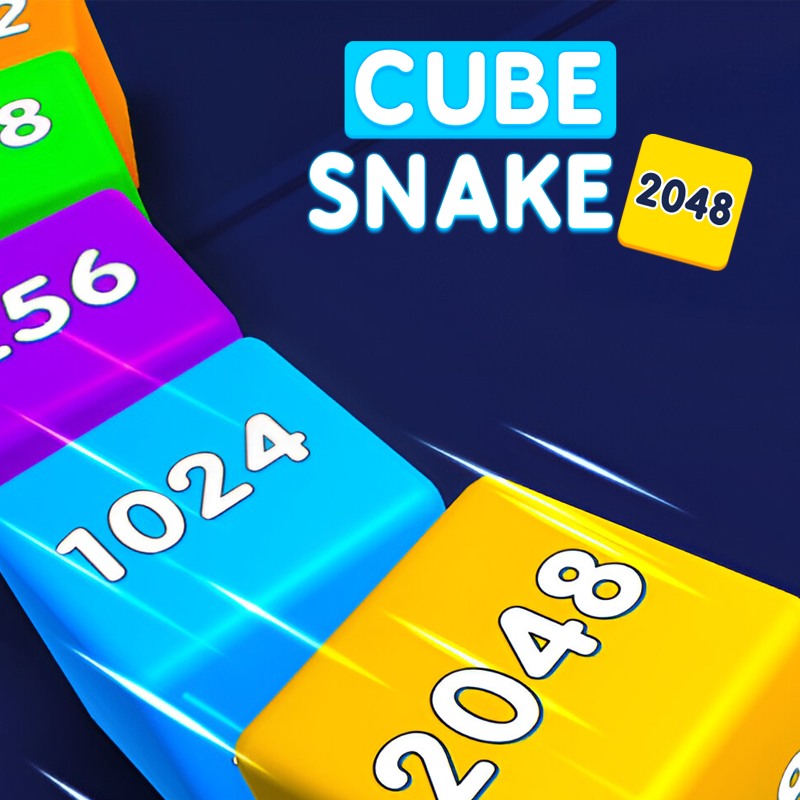
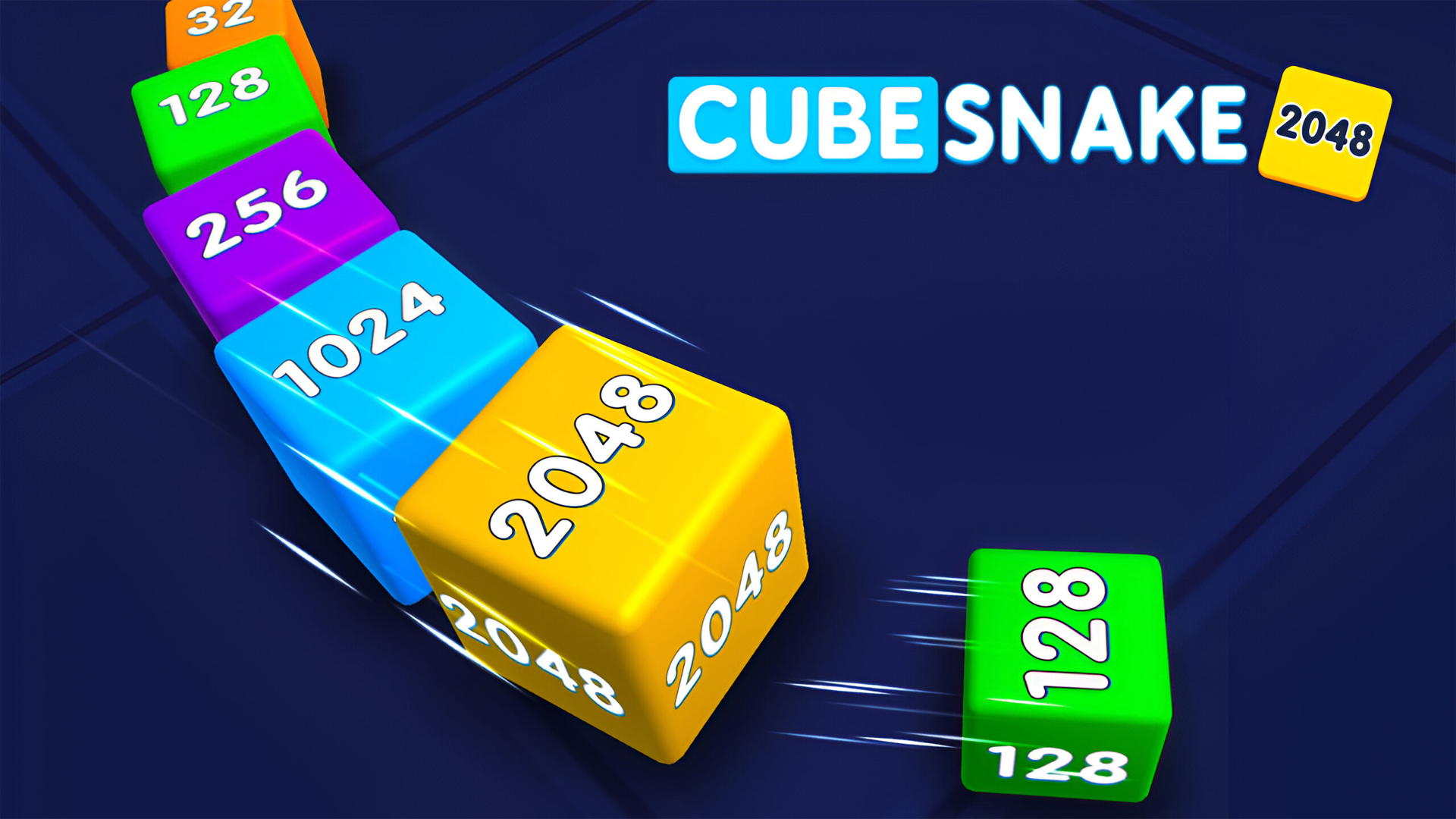
Imagine if Snake met 2048 and they had a hyperactive kid that sprints around collecting numbered blocks. That's Cube Snake 2048 in a nutshell. You control a growing chain of cubes in a huge arena, gobbling up smaller numbers to merge them into bigger ones. The goal? Build the longest, highest-value snake possible while dodging cubes that'll break your chain. It's collecting mayhem wrapped in simple math.
Getting started is dead simple, but staying alive when your snake gets massive? That's the real challenge.
You steer your snake using your mouse, arrow keys, or A and D on the keyboard. Move around the dark blue arena looking for cubes with numbers lower than or equal to your current head value. Bump into them to absorb them into your tail. Each successful merge doubles the value—just like 2048. Your snake grows longer with every cube collected, so early game is all about scooping up those easy 2s and 4s.
Here's where it gets tricky. Any cube with a higher value than your head will destroy part of your snake if you touch it. As your snake gets longer and your head value climbs into the hundreds or thousands, the arena fills with dangerous high-value blocks. You'll be weaving through gaps, using the boost button (left-click or spacebar) to escape tight situations. The speed lines kick in when you boost, and honestly, it feels like you're drifting a neon train through a minefield.
Your real objective is hitting those massive multipliers—4K, 8K, 16K cubes glowing in purple and gold. The longer you survive and the smarter you merge, the higher your score climbs. Power-ups scattered around the map give you temporary advantages like extra speed or invincibility. There's no final "win" screen—this is pure arcade-style score chasing. Your run ends when you crash into a killer cube or box yourself in with your own tail.
Perfect for casual players who want something quick and brainless during a coffee break or commute. If you liked the original Snake on old Nokia phones or got hooked on 2048 back in the day, this scratches that same itch. Kids will pick it up instantly since the rules are simple and there's zero violence—just colorful cubes and numbers. Not really for hardcore gamers looking for deep strategy, but if you want a mindless dopamine loop while watching Netflix, this works.
It's weirdly hypnotic. The game has that "just one more run" pull where you keep restarting to beat your high score. Visually, it's super bare-bones—flat-shaded cubes, a plain grid floor, and basic particle trails when you boost. It looks exactly like those hyper-casual mobile games that flood app stores, and honestly, it probably shares assets with a dozen other titles. There's no music that I noticed, just generic whoosh sounds when you collect cubes. The color-coding helps a lot—lower values are blue and green, mid-range goes orange and red, and the endgame purples and golds really pop. It's not pretty, but it's functional and smooth.
The game doesn't save progress between sessions since every run is a fresh start—it's all about chasing your personal best score each time. Performance-wise, this thing runs like butter even on ancient hardware. The low-poly graphics and simple lighting mean you won't get any lag, even on a five-year-old phone. I didn't encounter any bugs, though the controls can feel a bit slippery when you're moving fast—sometimes I'd overshoot a cube I was aiming for during a boost.
A solid time-waster that nails the "easy to learn, hard to master" formula, but don't expect anything groundbreaking.
Responsive enough for what the game demands, though the boost can feel slippery during tight maneuvers.
Developed by Cursora Labs and released on August 18, 2025. It's a fresh release, so expect possible updates or tweaks down the line.